





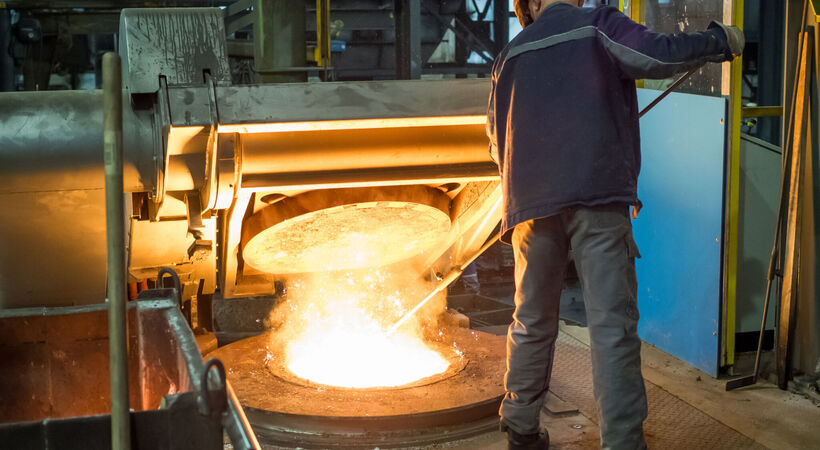
Otto Junker has commissioned a Monomelt medium-frequency coreless induction furnace plant at Eisengießerei Th. Schultz in Warendorf, Germany.
The project represents the complete conversion of the foundry to electric melting technology and forms part of the company’s long-term transformation towards decarbonisation and an increased energy efficiency.
With a power of 1,200 kW and a capacity of 1,700 kg of cast iron, the Otto Junker furnace replaces the cupola used previously and lowers CO₂ emissions during the melting process by approximately 330 tons per year.
As well as precise process control, the system allows for a stable power control which can be ideally integrated into existing energy structures.
A central element is the glycol-free air/water re-cooler with integrated heat recovery.
It uses the heat produced during the cooling process for reverting energy into downstream processes thus increasing the overall efficiency of the business.
This solution reduces energy consumption, avoids additional operating resources and lowers maintenance requirements.
The OCP+ temperature monitoring system has been installed for permanent process monitoring.
It continuously detects coil and crucible temperatures, providing a high operational safety.
Due to the modular arrangement of the Monomelt system, the equipment could be adapted to the spatial and energetic conditions on site.
Klaus Schultz, General Manager of Eisengießerei Schultz, said: "The conversion to induction was a logical step for us on our way towards CO₂ neutrality.
"The plant runs reliably, and we see significant efficiency gains in everyday operation."
Andreas von Wachtendonk, Regional Sales Manager – Foundry Plants, Otto Junker, added: "The project shows how conventional foundry processes can be made sustainable with modern technology – and still be economical."
The plant has been running at full capacity since February 2025. Compared to the cupola used previously, the energy consumption has been reduced by about 50% while at the same time process stability has been increased and a more homogeneous melting quality has been achieved.
In addition, workplace comfort has been improved due to lower dust and noise emissions.
The conversion required close cooperation between Otto Junker and the customer: From the planning and design stage and the integration into the existing infrastructure to the commissioning and training of the operating personnel.
Throughout the foundry industry, induction furnaces have established themselves as an efficient and sustainable technology.
They enable precise temperature control, flexible batch sizes and can be directly operated by means of renewable power – a decisive advantage in the course of the industrial energy transition.
Particularly for medium-sized companies, the change from fossil combustion to electrical melting processes offers a practical solution in order to achieve emission and efficiency targets.