





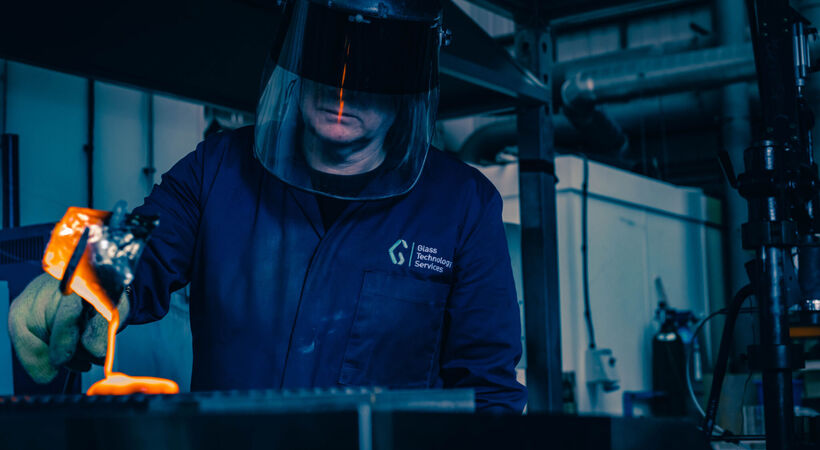
Glass Technology Services (GTS) has completed the construction and commissioning of a large-scale research furnace at its Sheffield, UK laboratory facility.
The completion marks a major expansion of its capabilities in glass melting and materials innovation.
GTS has been carrying out research in mainstream and specialist glass fields for more than 100 years, but until now, glass melting trials have been limited to batches of a maximum of 2kg per melt.
The new furnace enables melts of up to 50kg, and provides a greater representative scale for research trials and pre-commercial development.
The development of its High Temperature Melting Observation System (HTMOS) is a melting facility designed to GTS’s own specification by A.F.T (UK) with a range of bespoke components to enable better glass observation, measurement and control.
GTS Chief Executive Gareth Jones said: “By bridging the gap between small-scale laboratory melts and industrial production, we can offer our partners and clients deeper insight, greater confidence, and a faster route to innovation.”
GTS’s larger melting capacity will alongside existing melting capabilities enabling staged glass trials to validate findings from small-scale melts.
The furnace is equipped with an expanded suite of analytical tools that transform GTS’s ability to observe and quantify melting behaviour.
The new furnace also enables melting up to 1600°C, opening pathways for the development of new glass compositions, including advanced and high temperature formulations.
Martyn Marshall, Melting and R&D lead said: “The new melting capabilities are a real gamer-charger for us and the companies we work with.
“For the first time we can trial new glass formulations, recycled streams, raw materials and other innovations at a scale that genuinely reflects what happens in industry and with instrumentation that gives us a front-row seat to every reaction taking place.
"This means we can give customers answers backed with more data that will give them greater predictive results and confidence when moving towards full-scale production.
“For companies pushing for sustainability, efficiency or completely new glass technologies, this furnace opens doors we simply couldn’t open before and we’re incredibly excited for future innovations to come.”
Funding for the new furnace was obtained through a public tender contract awarded by Glass Futures as part of the Foundation Industries Sustainability Consortium (FISC) EconoMISER 2 project from UK Research and Innovation (UKRI).
